
Why Does Your Dog Need an Orthopedic Mattress? The Truth That May Surprise You
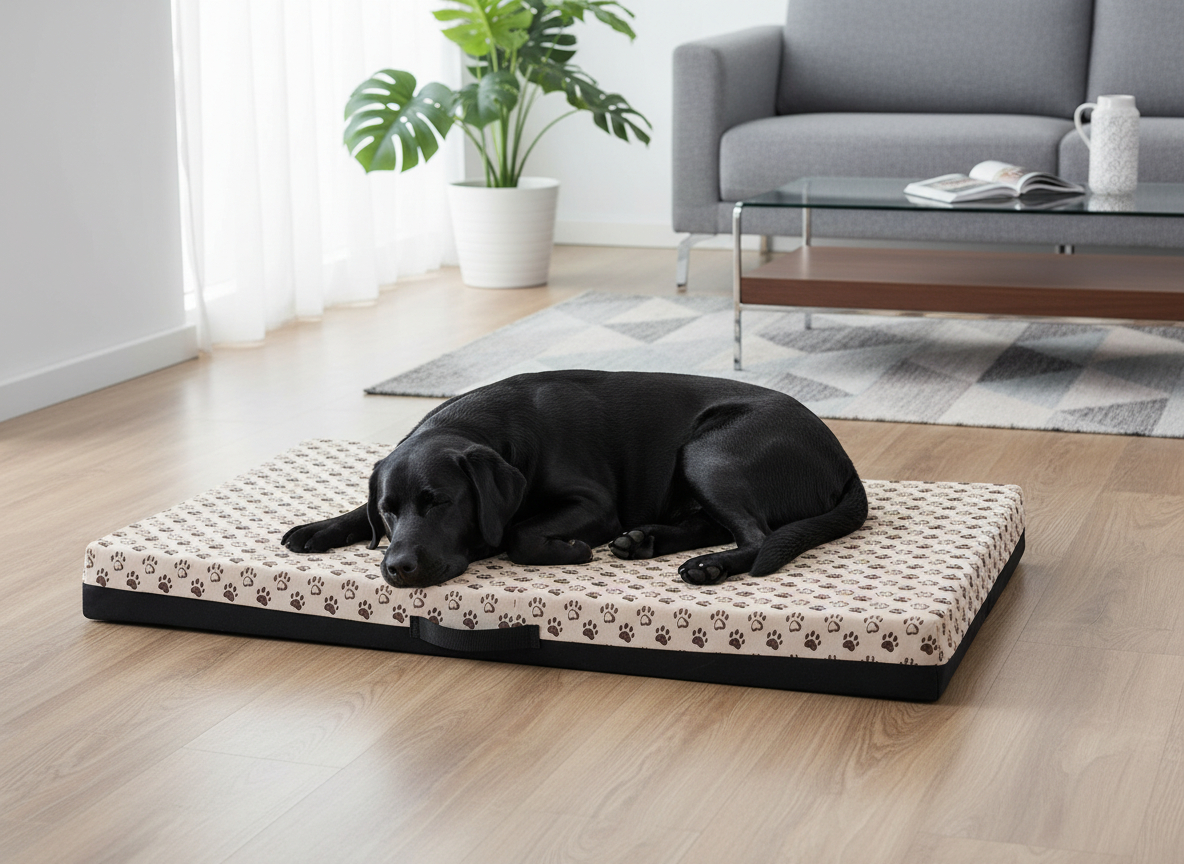
Ask yourself honestly: where does your dog sleep? On cold tiles? On a thin fleece bed that flattens completely after three weeks? Or on an old sofa throw? If you nodded at least once, keep reading – this may be one of the most important articles you will read for your dog.
Dogs sleep 50 to 60% of their lives. That is literally half of their existence. And yet most owners pay less attention to choosing a dog bed than they do to choosing their own pillow. The quality of the place where your dog rests directly affects their health, mobility, mood and even lifespan.
What exactly is an orthopedic mattress for dogs and how is it different from a regular dog bed?
The word “orthopedic” is not just a marketing phrase. An orthopedic mattress is designed to actively support the musculoskeletal system – joints, spine, muscles and ligaments – throughout the entire rest period.
The key is the material: memory foam, technically viscoelastic polyurethane foam. This material was originally developed for NASA in the 1960s and is now used in medical aids, rehabilitation equipment and premium human mattresses. It reacts to body heat and pressure – slowly adapting exactly to the dog’s shape, distributing weight evenly and eliminating so-called pressure points, where a bone or joint presses against a hard surface.
A regular dog bed cannot do this. Hollow fibre, shredded foam or cheap foam filling quickly deforms, stops supporting the body and the dog effectively lies on a hard surface with only a thin layer of fabric.
At CoolPet, we use only solid memory foam slabs – no shredded foam, no leftover pieces, no compromises. Each mattress is made from one piece of high-quality foam that keeps its shape and supportive properties throughout the entire lifetime of the product.
Science is clear: an orthopedic mattress really works
This is not just theory. There is concrete scientific evidence:
A University of Pennsylvania study – one of the few clinical studies focused directly on orthopedic beds for dogs – followed large dog breeds with arthritis for 3 years. The results were convincing:
- Significant reduction in pain and joint stiffness
- Improved mobility and walking
- Better quality of night rest
- Higher overall energy and vitality
Veterinary orthopedic specialist Dr. David Dycus, Chief of Orthopedics at Nexus Veterinary Bone & Joint Center, confirmed that a high-quality orthopedic bed improves sleep quality in dogs regardless of whether they suffer from arthritis or not.
Other research suggests that up to 80% of large older dogs suffer from joint pain – and many of them do not show it visibly, because dogs are naturally programmed to hide pain.
From puppy to senior: why age matters
Puppies and young dogs: prevention that pays off
Many owners think an orthopedic mattress is “only for old dogs”. This is one of the most common misconceptions.
Puppies have soft bones and joints that are still developing. Sleeping on a hard or uneven surface can negatively affect the proper development of the musculoskeletal system during this critical growth phase. Memory foam supports natural posture and correct weight distribution exactly when the body is forming.
In addition, your dog gets used to a quality resting place from an early age – and you can avoid future problems and veterinary bills.
Prevention is always cheaper than treatment.
Adult and active dogs: recovery after performance
Active dogs – whether sporting, working or simply dogs that take long walks every day – put intense strain on their musculoskeletal system. Muscles, tendons and joints need quality recovery after activity.
Memory foam supports blood circulation in tissues, reduces inflammatory processes in the joints and allows the body to truly recover – not just “get through” the night on a hard surface.
This is especially true for large and heavy breeds: Labrador Retriever, German Shepherd, Golden Retriever, Bernese Mountain Dog, Great Dane, Rottweiler or Newfoundland. The bigger the dog, the greater the pressure on the joints and spine with every lie-down and stand-up. These breeds are also genetically predisposed to hip dysplasia and arthritis.
If you have a large or heavy dog, this is not a luxury – this is a health necessity.
Older dogs: when an orthopedic mattress becomes almost essential
Aging brings inevitable changes: cartilage wears down, joints lose synovial fluid and muscles weaken. Arthritis affects an estimated 20% of all dogs over 1 year old, and the percentage is significantly higher in dogs over 7 years old.
Symptoms you may be overlooking:
- Your dog gets up slowly in the morning and needs time to “walk it off”
- Hesitates to jump into the car or onto the sofa
- Limping noticeably after a longer walk
- Is less playful and more tired
- Seeks out soft surfaces such as carpet or your bed
If you recognize your dog in these signs, it is time to act. An orthopedic mattress cannot cure arthritis, but it can significantly reduce pain, improve mobility and increase the quality of life of your senior dog. Today, veterinarians recommend it as part of comprehensive care for dogs with mobility problems – alongside physiotherapy, suitable nutrition and medication if needed.
The biggest risks for dogs without an orthopedic sleeping surface
Let’s say it directly – what can happen if your dog sleeps in an unsuitable place?
| Risk | Description | Most at-risk group |
|---|---|---|
| Hip dysplasia | Incorrect joint loading during rest can accelerate the development or worsen the course of dysplasia. | Large breeds, puppies |
| Arthritis and joint inflammation | A hard surface increases pressure on the joints, worsening inflammation and pain. | Older dogs, heavy breeds |
| Spinal problems | Incorrect sleeping position causes chronic overloading of the spine and intervertebral discs. | Dachshunds, bulldogs, all breeds |
| Hygromas, pressure sores on elbows | Repeated pressure from a hard surface on the elbow joints causes painful fluid-filled swellings. | Large and heavy breeds |
| Poor-quality sleep | Because of discomfort or pain, the dog wakes up and cannot reach deep sleep phases – affecting immunity, mood and recovery. | All dogs |
| Chilling | Cold tiles or concrete floors draw body heat away, especially in winter – increasing the risk of muscle and joint inflammation. | Short-haired and smooth-coated breeds, seniors |
Why foam quality matters: solid slab vs. shredded foam
This brings us to a topic that advertising rarely talks about – but it should.
There are two main types of fillings on the market labelled as “memory foam”:
1) Solid memory foam slab
One compact piece of foam precisely sized for the mattress. It distributes weight evenly across the entire surface, does not lose shape, does not let pressure through to the floor and truly performs its orthopedic function throughout its lifetime.
2) Shredded foam
Waste pieces and leftovers from foam production, chopped foam or a mixture of different materials. It may look similar, but behaves completely differently – the pieces move around, gather at the edges, create uneven pressure points and after a short time stop providing any real support. The dog effectively ends up lying on a pile of rags.
At CoolPet, we manufacture exclusively from solid memory foam slabs. No shredded foam, no waste pieces, no compromises at the expense of your dog’s health. Every mattress undergoes quality control and is designed to truly work – not just look good in a photo.
Which dogs is a CoolPet orthopedic mattress most suitable for?
The honest answer? Every dog. But there are groups for whom it is literally a priority:
- Large and heavy breeds such as Labrador, German Shepherd, Golden Retriever, Great Dane, Rottweiler, Bernese Mountain Dog, Newfoundland, Irish Wolfhound
- Older dogs from 7 years and above
- Dogs diagnosed with dysplasia, arthritis or other mobility problems
- Dogs after surgery or injury of the musculoskeletal system
- Active and sporting dogs such as agility, canicross and working dogs
- Puppies of large breeds during intensive growth
- Overweight dogs with increased joint load
How to tell that your dog needs a better place to sleep – right now?
Watch for these signs:
- Your dog takes longer than before to “walk it off” in the morning
- Groans or sighs when getting up
- Seeks soft surfaces such as carpet, your bed or the sofa
- Refuses to lie in their own bed
- Clearly limps after a longer rest
- Is less active and gets tired faster
- Has pressure marks or hard spots on the elbows
If you checked even one point, it is time for a change.
Conclusion: Your dog deserves it
Your dog gives you everything – loyalty, joy and unconditional love. Are you giving them the best you can in return? Quality sleep and a healthy musculoskeletal system are the foundation of a long, happy and active dog life.
A CoolPet orthopedic mattress is not an expense – it is an investment. In your dog’s health, in lower veterinary costs in the future and in the peace of mind that you are doing the maximum for your four-legged friend.
Because every dog – from the smallest dachshund to the largest Irish Wolfhound – deserves to sleep like a king.
CoolPet is a Czech manufacturer of orthopedic mattresses for dogs of all sizes. Our mattresses are made from solid slabs of the highest quality memory foam – no shredded foam, no compromises. Browse our range and find the right one for your dog.
CoolPet tip: Not sure what size to choose? Your dog should have enough space on the mattress to fully stretch out in both length and width. Always measure your dog in the position in which they sleep most often and add at least 15–20 cm extra on each side.